In today’s fast-moving professional world, finding the right opportunity or the right talent shouldn’t feel like searching for a needle in a haystack.
Yet for many professionals in aviation, healthcare, and technology, that’s exactly what job searching has become.
For years, professionals across industries have relied on large job platforms to find opportunities, grow their careers, and connect with employers.
But here’s the reality: scale has come at the cost of relevance.
And that’s where JobsReach is redefining the experience.
Enter JobsReach, an industry-specialized career and hiring ecosystem designed to serve niche professional sectors with precision, intelligence, and community at its core.
🔍 An Industry-Centric Alternative to Generic Job Platforms
Traditional job platforms cast a wide net. They aim to serve everyone across every profession. While that scale brings visibility, it often sacrifices relevance.
JobsReach takes a different approach.
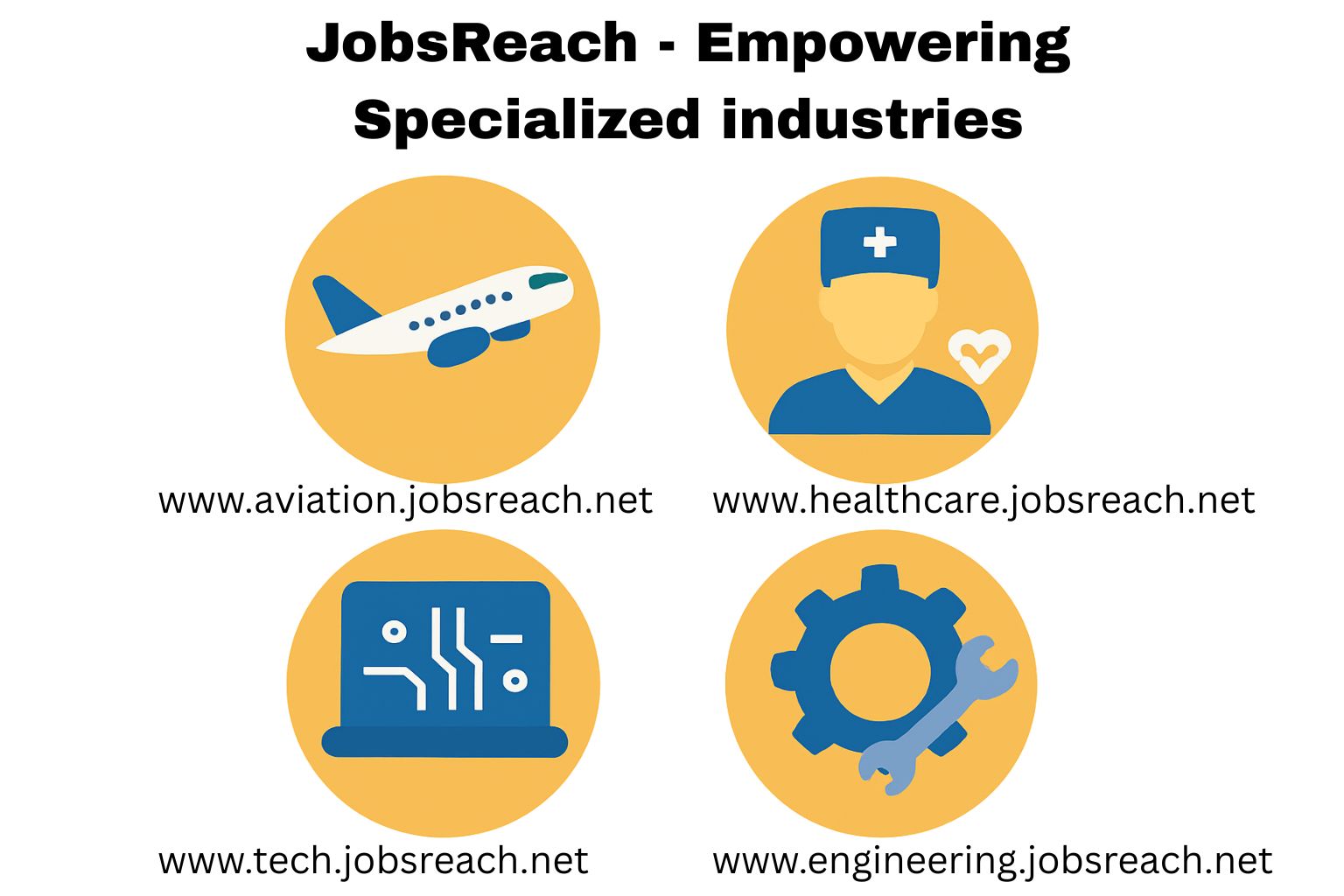
Instead of broad listings and generalized networking, it offers dedicated ecosystems for:
✈️ Aviation
🏥 Healthcare
💻 Technology
Each ecosystem is tailored to the unique hiring demands, skill structures, and certification requirements of its industry.
The result? More relevance. Less noise. Better matches.
Why This Concept Matters Today
Across aviation, healthcare, and technology, structural challenges are reshaping hiring.
📍 High Demand & Skill Shortages
Aviation faces projected shortages of pilots, technicians, and air traffic professionals.
Healthcare continues to struggle with workforce gaps, especially in specialized and critical care roles.
Technology evolves faster than traditional hiring pipelines can keep up.
Employers urgently need qualified, certified, and experienced professionals efficiently.
At the same time, professionals need visibility, clarity, and direct access to opportunity.
JobsReach was designed to bridge that gap.
The Bigger Vision
JobsReach represents a shift in how specialized industries approach hiring.
It blends:
Industry specialization
AI recruitment technology
Professional networking tools
Knowledge-sharing resources
For professionals who feel underserved by broad platforms, this industry-centric model offers a more relevant and empowering alternative.
It’s not just about finding a job. It’s about building a career within a community that understands your profession.
And that’s what makes JobsReach different.
If you’re ready for a smarter, more focused way to connect talent with opportunity, the future of industry hiring may already be here.
🧠 More Than a Job Platform — A Career Ecosystem
Beyond hiring tools, JobsReach strengthens its ecosystem through a dedicated knowledge base that:
Shares industry insights and career advice
Highlights emerging skills and market demand
Positions employers as thought leaders
This continuous learning environment supports long-term career growth not just job placement.
What JobsReach Does Differently
JobsReach is more than a listing site, it’s a connected career ecosystem built on these pillars:
🧠 1. AI‑Driven Precision Matching
JobsReach uses intelligent AI algorithms to:
Analyze job requirements and candidate profiles
Automate tailored candidate screening
Recommend jobs based on real skill match (not just keywords)
This reduces irrelevant applications and speeds up hiring cycles.
🤝 2. Deep Industry Engagement
Professionals gain specialized networking tools and communities where they can:
Exchange insights and trends
Showcase expertise through personalized profiles and video introductions
Participate in mentorship and workshops with industry peers
📚 3. Career Growth & Knowledge Tools
Beyond jobs, JobsReach strengthens professional development by:
Publishing industry insights and trend data
Sharing curated career advice tailored to each sector
Helping candidates understand emerging career paths and skill demands
What JobsReach Looks Like in Action
JobsReach is not a concept, it’s a growing ecosystem already in motion.
Through platforms like AviationJobsReach and Healthcare JobsReach, professionals gain access to highly targeted opportunities aligned with their certifications, experience, and career paths.
At the same time, the JobsReach Blogs and knowledge base provide continuous insights into industry trends, emerging skills, and career strategies bridging the gap between learning and hiring.
This integrated approach transforms job searching from a fragmented process into a connected career journey.
💡 What Makes JobsReach Truly Different
JobsReach is more than a job platform. it’s a dynamic industry ecosystem designed to foster peer-to-peer networking and meaningful professional connections. Within the platform, professionals and employers can:
Connect with peers and industry leaders to expand their global network
Gain insights and share opportunities specific to their field
Ask questions and engage in community discussions
Mentor and learn from others, sharing expertise and real-world experience
Actively contribute to the industry conversation, building visibility and credibility
In short, JobsReach empowers professionals to not just find jobs, but to grow, collaborate, and thrive within a connected industry network.
The Future of Industry Hiring
For professionals who feel lost in crowded platforms… For employers struggling to find the right talent…
JobsReach offers a smarter, more focused alternative.
It’s not just about finding your next job. It’s about building your career in a space designed for your industry.
👉 The future of hiring isn’t bigger platforms. 👉 It’s better, smarter, industry-focused ecosystems.
And that future is already taking shape with JobsReach.
Healthcare remains one of the fastest‑growing employment sectors in Europe, with strong demand in clinical, administrative, research, allied health and tech‑driven roles. In the Netherlands, a hub of world‑class healthcare systems and education opportunities are expanding for both domestic and international professionals willing to meet local qualification and regulatory standards.
This guide covers the top 10 healthcare careers, required qualifications, visa and labour entry pathways, and relevant Dutch educational institutions and training programs to help you plan your career path in 2026 and beyond.
1. Registered Nurse (RN)
Why in Demand: Aging populations and expanding hospital services drive demand.
Qualifications:
Bachelor of Nursing (HBO Verpleegkunde) or equivalent degree.
In the Netherlands, nurses must register with the BIG‑register before practicing in regulated roles such as injections or medical procedures.
Visa / Local Requirements:
For non‑EU professionals, employers can sponsor a GVVA (combined residence & work permit) or Highly Skilled Migrant status when salary thresholds are met.
Language: Dutch proficiency (often B1/B2 CEFR) is essential in patient‑facing roles.
Foreign qualifications must be recognized, and you may be asked to complete supplementary training or adaptation.
Educational Institutions (NL):
HAN University of Applied Sciences – School of Health Studies – Nursing, Allied Medical Care.
Amsterdam University of Applied Sciences (AUAS) – Health degree programmes.
Hanze UAS – International Health Care School – Nursing, Physiotherapy, Related health studies.
Hogeschool van Amsterdam (HVA) – Health and nursing pathways.
Windesheim University of Applied Sciences – Healthcare and wellbeing programmes.
Zuyd University of Applied Sciences – Nursing and healthcare tracks.
2. Medical Laboratory Scientist / Clinical Lab Technician
Qualifications:
Bachelor’s or associate degree in clinical laboratory science or related biomedical field.
Visa / Local Requirements:
Foreign degrees generally require recognition to meet Dutch labour standards.
Depending on job role, language requirements and registration with relevant associations may apply.
Educational Pathways:
Many Dutch universities of applied sciences (e.g., Inholland UAS, others) offer biomedical, laboratory and allied health programmes, with opportunities for international exchange/credits.
3. Allied Health Professionals (Physiotherapists, Radiographers, Occupational Therapists)
Qualifications:
Accredited bachelor’s degree in a relevant allied health discipline.
Visa / Local Requirements:
EU professionals benefit from automatic mutual recognition under EU professional qualification rules when available.
Non‑EU professionals must have diplomas recognized and may need a professional competence certificate from the relevant Dutch authority.
Institutes:
HAN University of Applied Sciences – Allied medical care and related tracks.
Windesheim – Physiotherapy, therapeutic care.
Hanze UAS – Physiotherapy and speech therapy programmes.
4. Healthcare Administrators / Hospital Managers
Qualifications:
Bachelor’s in Healthcare Administration, Health Management or related field.
Master’s degrees advantageous for senior roles.
Visa / Local Requirements:
Generally non‑regulated, meaning qualification recognition is employer‑specific and less stringent than clinical roles. However, work contract and residence permit rules still apply.
Institutes / Courses:
Business and management programmes with healthcare specializations are offered at many universities of applied sciences.
5. Medical Researchers / Clinical Scientists
Qualifications:
MSc or PhD in biomedical, clinical sciences or related discipline.
Visa / Local Requirements:
Research roles may be sponsored under the Highly Skilled Migrant or EU Blue Card schemes if salary and contract criteria are satisfied.
Academic research often requires strong language skills and project‑specific credentials.
Institutes:
Universities with biomedical faculties (e.g., Leiden, Utrecht, Amsterdam) often embed research pathways.
6. Pharmacists / Clinical Pharmacologists
Qualifications:
Master’s in Pharmacy and national registration/license where applicable.
Visa / Local Requirements:
Pharmacists are recognised regulated professions; diploma recognition is required for practice in the BIG or national register.
7. Mental Health Professionals (Psychologists, Psychiatrists, Counselors)
Qualifications:
Psychology degrees with master’s and specific professional licensing (varies by role).
Visa / Local Requirements:
Regulated roles require recognition in the Netherlands overviewed by the Regulated Professions Database.
8. Emergency Medical Technicians (EMTs) / Paramedics
Qualifications:
Vocational or bachelor training in emergency care.
Visa / Local Requirements:
EMT roles may be less tightly regulated than nurse/doctor; however, qualification evaluation and Dutch language ability remain important.
9. Health IT Specialists / Digital Health Experts
Qualifications:
Degrees in Health Informatics, IT or related tech fields.
Visa / Local Requirements:
Non‑regulated roles can often be sponsored under general work permits if skill thresholds and language requirements are met.
10. Public Health Specialists / Epidemiologists
Qualifications:
Bachelor’s and often master’s in public health or epidemiology.
Visa / Local Requirements:
Typically non‑regulated, professionals may work on research, policy, or NGO projects with appropriate employment contracts.
Visa & Labour Entry Pathways (for Foreign Professionals)
EU / EEA Citizens
EU qualifications in regulated professions (e.g., nurse, physiotherapist) may be recognized under mutual recognition agreements.
For practice, professionals must still register with Dutch authorities like the BIG‑register if applicable.
Non‑EU / International Citizens
Key Work Visa Paths:
GVVA (Combined Permit) – Employer‑sponsored work & residence permit.
Highly Skilled Migrant Permit – Employer‑sponsored, for skilled roles with salary thresholds.
EU Blue Card – For highly qualified workers (higher salary threshold, mobility benefits).
Orientation Year Visa (Zoekjaar) – For recent graduates to search for employment.
Professional Recognition Steps:
Have foreign professional diploma recognized by relevant Dutch authority.
In regulated roles, register with bodies like the BIG‑register to legally practice.
Often you must demonstrate Dutch language proficiency (varies by profession but generally B1/B2+ for clinical interaction).
Language & Local Integration Tips
Dutch proficiency is frequently required in clinical roles because patient communication is essential.
Employers often offer language support once hired, especially for care assistant positions.
Some specialised integration programs exist to help foreign healthcare professionals adapt to Dutch standards and practice.
Educational & Training Institutions in the Netherlands
Here’s a list of notable institutions offering healthcare and related programmes:
Universities of Applied Sciences (HBO)
HAN University of Applied Sciences – School of Health Studies – Nursing, allied care.
Amsterdam University of Applied Sciences (AUAS) – Health degrees.
Hanze UAS – International Health Care School – Nursing, physiotherapy etc.
Hogeschool van Amsterdam (HvA) – Health and wellbeing pathways.
Windesheim University of Applied Sciences – Care and social work.
Zuyd University of Applied Sciences – Nursing ↔ health care.
Inholland UAS – Broad programmes including health‑related ones.
Specialised Courses & Training Providers
Private and part‑time training (e.g., NCOI Zorg & Wellzijn) for upskilling in care and management.
Who Can Sponsor a GVVA or Highly Skilled Migrant Visa for Healthcare Professionals
For non‑EU/EEA healthcare professionals seeking to work in the Netherlands, the most common work and residence permit routes are the GVVA (Combined Work & Residence Permit) and the Highly Skilled Migrant (HSM) visa. Both require a sponsoring employer that is recognised by the Dutch immigration authority (IND).
🧑⚕️ 1. GVVA (Combined Residence & Work Permit)
The GVVA (Gecombineerde Vergunning voor Verblijf en Arbeid) allows an employer to sponsor you for both residency and work in one application.
Who Can Sponsor GVVA? A GVVA sponsor must be:
A Dutch employer or organisation that is legally established in the Netherlands and
Recognised by the Immigration and Naturalisation Service (IND) as a GVVA sponsor or willing to apply for sponsorship status for the employee.
Examples of organisations that commonly sponsor GVVA for healthcare professionals:
Hospitals and medical centres
Nursing homes and long‑term care facilities
Rehabilitation & physiotherapy centres
Clinical laboratories and diagnostic institutions
University medical centres involved in research roles
Healthcare staffing agencies that place international professionals with healthcare clients
💡 Important: Not all employers are automatically approved as GVVA sponsors, the company must either already hold sponsor status with the IND or apply for it before hiring a non‑EU professional.
🧑⚕️ 2. Highly Skilled Migrant (HSM) Visa
The Highly Skilled Migrant scheme is designed for employers to recruit international talent into specialised or high‑skilled roles, often with higher salary thresholds than regular work visas.
Who Can Sponsor Highly Skilled Migrant? To sponsor an HSM visa, the employer must be:
Recognised by the IND as a Highly Skilled Migrant sponsor
Able to pay at least the minimum salary requirement for HSM roles
Must meet a defined minimum gross salary level (higher than standard GVVA), which varies with age and role seniority.
⚠️ If the salary isn’t above the HSM threshold, the employer can still sponsor a GVVA instead, provided the role meets the IND definition of employment.
Employer Requirements to Sponsor
Regardless of visa type, the sponsoring employer must:
✔ Be legally registered and operating in the Netherlands ✔ Have a positive track record with the IND (good HR practices) ✔ Commit to the financial responsibilities of hiring foreign talent ✔ Provide a valid employment contract and meet salary standards
What Types of Healthcare Roles Typically Get Sponsored?
Commonly Sponsored Roles
These are roles where GVVA or HSM sponsorship is frequently approved:
GVVA Sponsors:
Nurses (ICU, ER, paediatrics, elderly care)
Allied health professionals (physio, occupational therapy, radiography)
EMT/paramedic roles
Healthcare assistants
Clinical lab technicians
HSM Sponsors (specialist or high‑skill roles):
Medical researchers (PhD/MSc level)
Health informatics / digital health specialists
Healthcare administrators / operations managers
Pharmacologists
Clinical trial experts
Public health specialists
How the Sponsorship Process Works (Step‑by‑Step)
Job Offer: You receive a formal employment contract from a Dutch sponsor.
Sponsor Application (if not already approved):
The employer applies or confirms existing sponsor status with the IND.
Submission to IND:
The employer submits the GVVA or HSM application to the IND on your behalf.
IND Decision:
If approved, you receive a combined residence & work permit or an HSM visa.
Entry & Residence:
You can travel to the Netherlands and start work under the permit.
Tips for Healthcare Professionals Seeking Sponsorship
✔ Target larger hospital networks & academic centres — more likely to have IND sponsor status. ✔ Prepare credential recognition early (especially for regulated roles like nursing). ✔ Highlight language willingness — show plans to learn Dutch if required. ✔ Use specialised recruiters who know the Dutch healthcare sponsorship landscape.
💰 2026 Highly Skilled Migrant Salary Thresholds (Minimum Income Requirements)
For a company to successfully sponsor an HSM visa, the healthcare professional’s monthly gross salary (excluding the 8% statutory holiday allowance) must meet or exceed the IND’s thresholds effective in 2026:
Category
Required Monthly Gross Salary (excl. holiday pay)
HSM – Age 30 and older
€ 5,942
HSM – Under age 30
€ 4,357
HSM – Reduced salary criterion (e.g., orientation year graduates)
€ 3,122
EU Blue Card (standard)
€ 5,942
EU Blue Card – Reduced
€ 4,754
(Thresholds for 2026)
🧠 What These Mean
Standard HSM criteria apply in most specialist, managerial and high‑skill healthcare jobs.
The reduced salary criterion is often available to recent graduates or those who previously held a search year visa.
EU Blue Card is another pathway with similar requirements but includes additional EU mobility benefits.
🩺 Practical Examples for Healthcare Roles
Highly Skilled Migrant Sponsorship
A hospital hiring a health IT specialist or clinical researcher earning €6,000/month can sponsor them as an HSM because the salary exceeds the €5,942 threshold. The employer must be a recognized IND sponsor.
GVVA Sponsorship
A nursing home recruiting a registered nurse from outside the EU with a valid employment contract can apply for a GVVA on the nurse’s behalf, even if the salary doesn’t meet the HSM thresholds. The employer still must meet Dutch work permit regulations and submit the application correctly.
🧩 Key Things Employers Must Do to Sponsor You
Whether sponsoring a GVVA or an HSM visa, employers must:
✔ Be recognised as a sponsor by the IND ✔ Provide a valid employment contract with appropriate salary ✔ Meet Dutch labour conditions and reporting obligations ✔ Submit the permit application to the IND on your behalf
For highly skilled migrant applications, salary compliance is strictly checked based on the IND’s thresholds for 2026, so employers must plan accordingly.
📌 Pro Tips for Healthcare Professionals
✅ Check employer sponsor status before accepting a job offer only recognised sponsors can submit GVVA/HSM applications. ✅ Verify that the job contract meets salary criteria if you expect HSM or EU Blue Card sponsorship. ✅ Prepare credential recognition early, especially for regulated roles (nurses, therapists, pharmacists). ✅ Improve Dutch language skills many clinical and patient‑facing roles expect at least B1/B2 proficiency.
Conclusion
The Netherlands and wider Europe offer diverse healthcare career opportunities across clinical, allied, administrative, research and digital roles. To succeed — especially as a foreign professional — you must meet educational requirements, obtain professional recognition (e.g., BIG registration) for regulated roles, secure the appropriate visa, and often demonstrate Dutch language ability.
With the right qualifications and preparation, healthcare professionals can build rewarding careers in one of Europe’s most advanced health systems.
Looking beyond the Netherlands? Explore healthcare jobs abroad in the UK, Canada, and Gulf countries Healthcare jobs abroad to discover high-demand roles and global opportunities.
References
🇳🇱 Government & Official Immigration / Professional Recognition
In 2025, many specialized industries like aviation, healthcare, technology, engineering, and others faced systemic setbacks that go beyond cyclical business trends. These challenges were not just about economic headwinds, they revealed a deeper structural issue in how professionals connect, learn, and advance their careers.
In crowded digital environments dominated by generic social media and broad professional networks, the voices and needs of specialized industries are often hidden, buried under content that has little relevance to the specific skills, insights, and opportunities these professionals require.
To understand both the problem and the solution, it helps to look at the data.
📉 The Hidden Crisis in Specialized Industries
Healthcare: A Global Workforce Shortage
The healthcare industry continues to grapple with a massive talent gap:
A projected shortage of at least 10 million healthcare workers globally by 2030 has been identified, with serious implications for public health outcomes and economic growth. Closing this gap could avert 189 million years of life lost and add $1.1 trillion to the global economy. McKinsey & Company
Many healthcare organizations report difficulty recruiting staff with specialized digital health skills, even as demand for AI and telemedicine roles grows. WifiTalents
These shortages are not evenly distributed; they are most acute in roles that directly impact patient care, innovation adoption, and operational efficiency.
Aviation: Growth Without Enough Workforce
Although travel demand rebounded strongly post-pandemic, the aviation workforce has struggled to keep pace:
Estimates project a need for around 1.5 million new aviation professionals globally by 2034, spanning pilots, technicians, cabin crew, and air traffic controllers. VisaVerge
Aviation companies are investing heavily in upskilling, with 78% planning increased training, yet only about 35% of staff feel confident in their digital skills. WifiTalents
This mismatch between workforce supply and industry growth threatens reliability, innovation adoption, and safe operations.
Tech & Engineering: Skills Gap Continues to Hamper Growth
The technology sector is facing some of the most intense competition for talent:
Nearly 50% of employers worldwide report difficulty finding candidates with the right skills, and 75% struggle to fill technology and digital roles. Market.biz
The World Economic Forum reports that 50% of employees will need reskilling by 2025 due to rapid technological change—a trend that spans across engineering and tech roles. Keevee
In engineering and industrial sectors more broadly, 73% of employers say they are struggling to find the skilled talent they need, particularly in engineering, manufacturing, and tech domains. ManpowerGroup Nederland
📣 Why Generic Platforms Fall Short
So why is this happening, even as workforce shortages become more visible?
Today’s major networking and job platforms are built for scale, not relevance. They prioritize broad engagement over focused industry insights, leading to several problems:
Noise over knowledge: Content unrelated to specific industries competes for attention, burying meaningful professional insights beneath marketing, lifestyle posts, and generic content.
Poor signal for specialized skills: Professionals in aviation, healthcare, technology, or engineering find it difficult to identify peer insights, emerging trends, and relevant opportunities.
Networking limitations: Generic platforms lack the context to facilitate deep mentorship, industry-specific collaboration, and targeted job matching.
In short, professionals are present but their communities and career pathways are not being supported.
🛠 The Case for Industry-Focused Platforms
To unlock the full potential of specialized industries, professionals need focused ecosystems where:
Skills and insights are shared among true peers
Career pathways are visible and navigable
Employers and candidates can connect directly on relevant terms
Mentorship and growth opportunities are embedded in the network
This is where specialized platforms make a difference.
🌐 Introducing the JobsReach Ecosystem
JobsReach is pioneering a new model of industry-focused professional networking and opportunity discovery:
🔹 JobsReach — A hub for industry-specific career growth and deep professional engagement. 👉 https://jobsreach.net/
🔹 JobsReach Aviation — A dedicated community for pilots, engineers, maintenance professionals, and aviation leaders. 👉 https://aviation.jobsreach.net/
🔹 JobsReach Healthcare — A space for nurses, clinicians, allied health professionals, administrators, and healthcare innovators. 👉 https://healthcare.jobsreach.net/
🔹 JobsReach Tech & Engineering — Designed for software developers, engineers, data scientists, cloud and cybersecurity experts, and technology leaders. 👉 https://tech.jobsreach.net/
These platforms are built not to replicate generic social feeds, but to elevate industry relevance ensuring professionals find insights, connections, mentorship, and opportunities tailored to their field.
🌟 The Way Forward: Growth Through Community and Mentorship
In 2026 and beyond, growth will no longer be about being everywhere online, it will be about being where it matters.
For aviation professionals, that means connecting with peers who understand the nuances of safety, regulation, and innovation. For healthcare workers, it means sharing insights on digital transformation and patient care frameworks. For tech and engineering professionals, it means collaborating around emerging technologies, skill pathways, and career acceleration.
Mentorship, community, and focused knowledge sharing will be the engines of future industry growth. Generic platforms cannot serve these needs effectively not when industries are evolving faster than ever.
With data showing persistent shortages, unmet training needs, and growing demand for specialized skills, the case for industry-focused networks has never been stronger.
Industry-focused platforms like JobsReach are stepping in to fill the gap for sectors such as aviation, healthcare, and technology.
JobsReach is leading this transformation bringing professionals together in the spaces where their careers and industries truly grow.